
Movie Monday Review: Singing in the Rain
- May 18, 2020
- 6 min read

Singing in the Rain (1952)
Starring: Gene Kelly, Debbie Reynolds, Donald O’Connor, Jean Hagen, Millard Mitchell, Cyd Charisse, Douglas Fowley, Rita Moreno
Summary
Silent movie performers, Don Lockwood (Gene Kelly) and Lina Lamont (Jean Hagen), are the hottest thing in America. Their next movie is about to premier and they will be in attendance. Crowds rush around the theater, hoping to see the two “love birds”. Also arriving for the performance are other famous silent movie actors, like Lina’s best friend Zelda (Rita Moreno). Each one is announced by the local columnist who has all the low-down on them.

When Don’s best friend, Cosmo Brown (Donald O’Connor) arrives, the crowd goes wild, hoping it is Lockwood and Lamont, but are very disappointed. Soon, however, the moment arrives, and the crowds go wild. They convince Don to tell the story of how he and Lina came together, in which he states his motto: Dignity, always dignity. At this Cosmo rolls his eyes, knowing full well that their upbringing wasn’t in fine schools and theaters, in front of the wealthy, but was actually a rough upbringing of dancing in bars as boys and finally landing music jobs in the dregs of any town they could find. Scrimping all over, until Don finally landed a job as stunt double, a person with whom Lina would not associate. But when forced together as performers, they pretend they are madly in love and the public believes it. Cosmo playing the piano backstage to help them “get into those romantic moods”.

The crowds are thrilled, however, to think that Don’s life was one of perfection from start to finish. Everything seems great as they watch the movie, until the end when Lina is frustrated that no one will let her make the closing speech. Although the public doesn’t know it, the studio knows that she has the most high-pitch and awkward voice around. This would ruin her public image.
Don is cut deep when he meets a woman named Kathy Selden (Debbie Reynolds) who doesn’t “fall for his Hollywood look”, telling him “if you’ve seen one movie, you’ve seen them all.” She insults his acting ability, claiming it’s not “real” acting, like stage acting is – her passion. She then drops him off at the studio party, little knowing she’d see him later, as she is one of the dance girls.
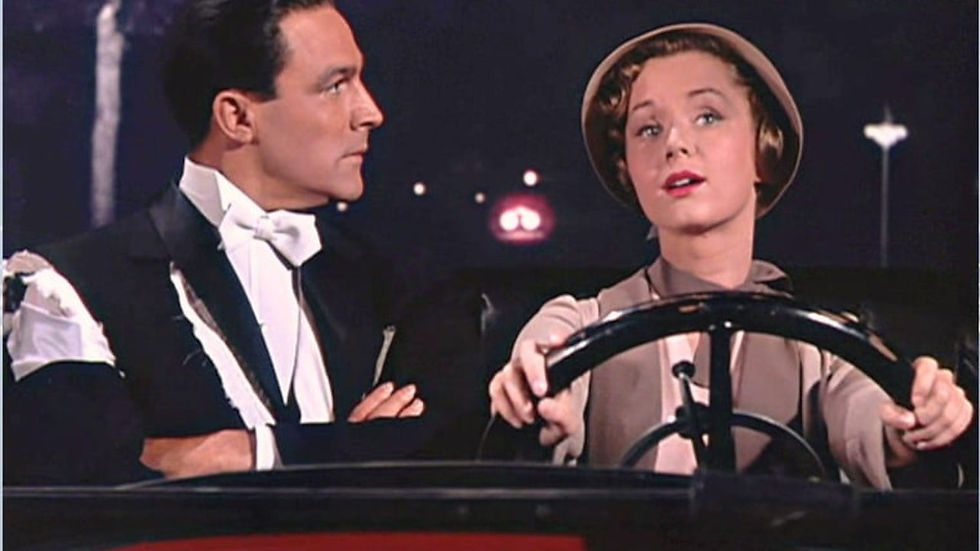
At the party, the concept of a “talking picture” is announced by the studio owner R.F. Simpson (Millard Mitchell). No one believes it can happen, but he believes it must in order to keep up with the rest of the studios.
When Don tries to talk with Kathy, teasing her about her role as dance girl instead of playing a role in a Shakespearian play. She picks of a cake to throw at Don, but misses and hits Lina. This is too much for Lina, who has her fired, with Don unaware.

Don can’t stop thinking about Kathy and starts searching all over. A long while later, Don is sulking about it and feeling low. He tells Cosmo about his new picture and Cosmo replies “if you’ve seen one, you’ve seen them all.” Don is now more down, because that’s what Kathy said. Cosmo must cheer up his friend and “makes him laugh.”

While watching the studio film a talking picture elsewhere, Cosmo sees Kathy. Soon, she and Don are united and the truth comes out that Don loves her. Kathy feels bad for the things she said to him before. They secretly begin seeing each other, behind Lina’s back.

Prepping for talking pictures, they begin working with diction coaches. While Don is doing just fine, Lina can’t lose her poor grammar and high-pitch voice. Upon watching the reel for the first movie, they realize it will be a disaster, their careers hanging by a thread. Lina is awful on screen and Don awkward with sound. After getting a pep-talk from Kathy and Cosmo, they decide that they have time to change the movie. This time, however, they are going to use Kathy’s voice over Lina’s, and put in some new scenes, making it a musical.

All is going well, until Zelda tells Lina what’s going on with her voice. When Lina finds out that Don is really in love with Kathy and not with Lina, she goes into a fit. Going to the newspapers, she leaks information that Lina Lamont is the best thing the studio has. This is different than they wanted, as they wanted to start building up Kathy’s career. R.F. Simpson doesn’t know what to do, but Lina is too much to the studio and he weakly goes along with her.

At the opening of their talking picture, the crowds go wild! They didn’t realize that Lina had such an “amazing voice” and want more. Lina tells Don and R.F. that they have no choice, Kathy must keep speaking for Lina. There’s no other way, and since she has a contract, she must do it. Don won’t stand for it, but R.F. isn’t brave enough to go against it. Lina is proud of herself and insists that she go make a speech. Don knows this is best, because then they’ll hear her real voice and he comes up with a plan.

When the crowds get flustered about Lina’s odd voice, she runs back seeking help. Don tells her that Kathy will stand behind the current and sing while Lina will be out front. Kathy is furious, but because of the contract, must do it. She never wants to see Don again, however, and does her duty. While they’re singing, Don, Cosmo, and R.F. open the current, allowing the audience to see that Kathy is really singing. Humiliated, Lina runs off. Sad, Kathy tries to run off, but Don stops her. He tells the audience this is the real hero of the movie and Kathy understands that he loves her. <3
Review
A fun movie with great music and amazing dancing. Donald O’Connor is nothing but amazing in his ability to do brilliant dancing and incredible acrobatics. He brings comedy to the film and helps it ease up in contrast to the difficulties that Gene Kelly’s character seems to always be facing. Donald O’Connor’s scene in “Make ‘em Laugh” is well worth the watch, his ability to get hurt so well and still be standing is interesting to watch. He was an amazing dancer and put his skills to much use.

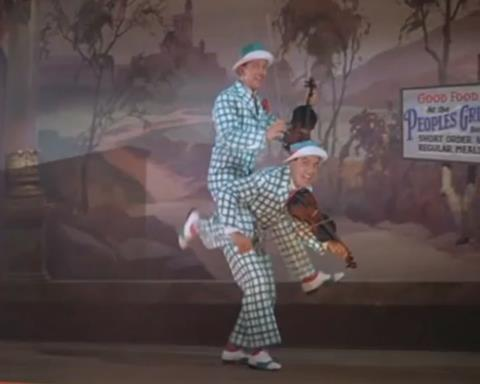
Another favorite dance scene is "Fit as a Fiddle", despite the fact that the audience doesn't like the song. It shows excellent dancing skills and amazing ability! The “Moses Supposes” scene with Gene Kelly and Donald O’Connor and plain fun! You get to see two amazing dancers who both have distinct styles, but manage to meld them together.

Overall, the movie does a decent job of representing the difficulty Hollywood had of transferring into the “talking picture” age and the issues related to voices. Needing to rely on looks alone before, now new jobs appeared for diction coaches who could help actors either succeed or fail in the new era. The reference to The Jazz Singer brought reality to the film, because it did create shock waves to entertainment world. The way Singing in the Rain portrays it, this is an unfathomable concept to be able to hear voices on a movie screen. In fact, most of them exclaim that it will never take off, with the exception of Donald O’Connor who quietly replies “That’s what they said about the horseless carriage.” He then makes reference to Al Jolson, by singing a bit of Mammy (Al Jolson was in the first talkie).
A word of caution to parents, the 5-10 minute dance scene featuring Cyd Charisse is more risqué than is appreciated for most audiences. Although not “inappropriate”, her dress is much shorter and her movements leave much to be desired. It has very little to do with the story as a whole and you can easily skip over that scene and not have missed much.

A unique teaching opportunity on the history of movies. A watching of The Jazz Singer (1927) might be appropriate afterwards, as the first “talking picture” around (with a pre-watch recommended for parents).
Ellen Nolan


Comments